HelioExpect
    Planner

    Plan the project before you commit.

    Find suitable land, assess a proposed plant and size solar, wind and storage for delivery. Bring engineering evidence and project economics into one planning workspace.

    Book a Planner demo
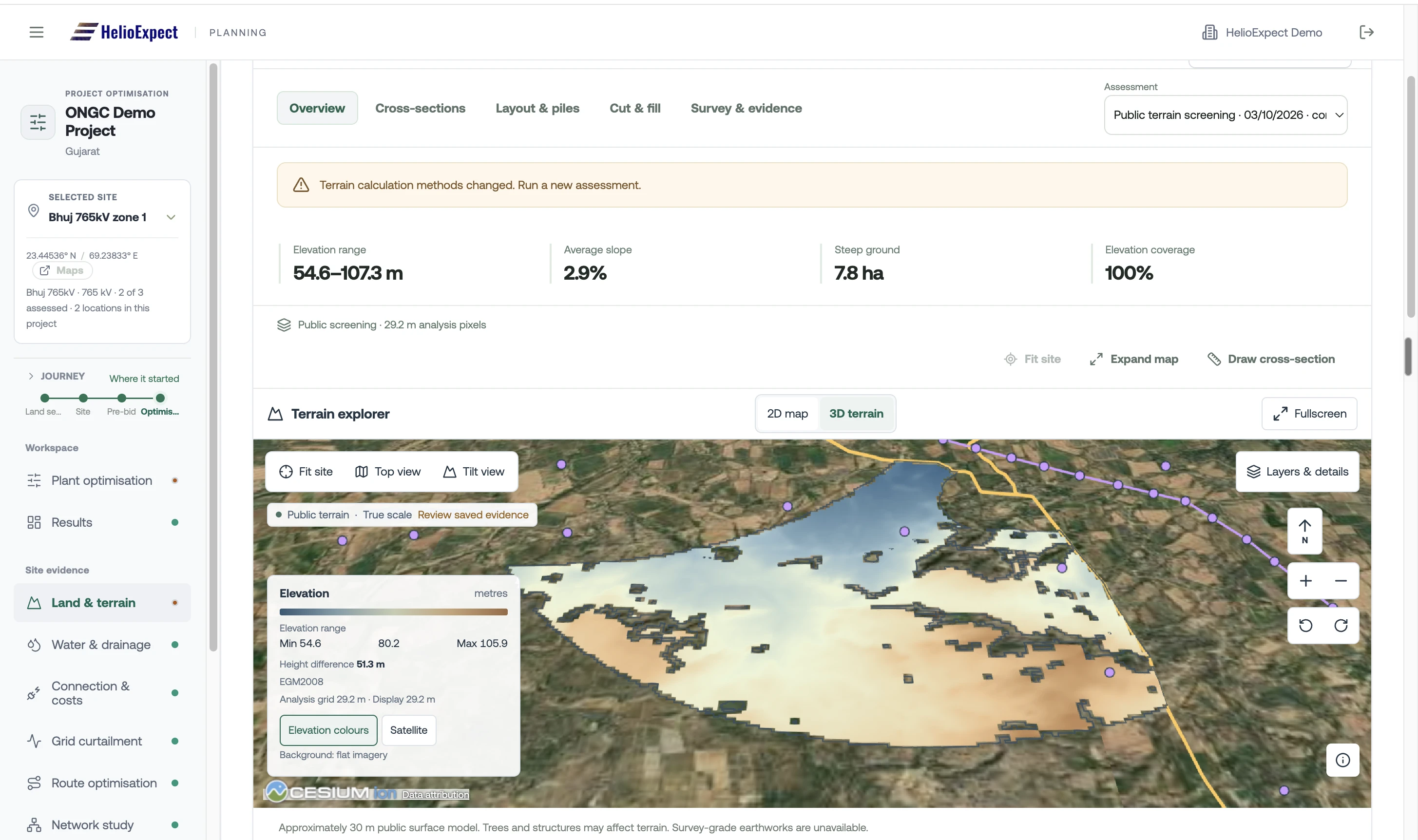
    Planner · Land & terrainDemo project
    Planner Land & terrain workspace for a demo project, showing a 3D terrain map, elevation colours, slope and coverage
    Actual Planner interface · Demo project
    Land → Design
    Connected project workflow
    Solar + wind
    Resource and generation
    MW + MWh
    Capacity and storage
    Evidence
    Retained with decisions

    Choose your starting point

    Start with the information you have.

    Begin with a known site, a search region or a supply requirement. Carry the inputs and evidence forward as the project develops.

    Read the Planner docs

    Your first workspace

    Pre-bid analyser

    Bring your location, boundary and proposed plant. Assess resource, land, grid options and indicative economics before shortlisting the project.

    What you take forward

    A saved assessment, a shortlist decision and clear evidence gaps.

    Explore Pre-bid analyser
    1. 01Plant sizingEstimate the requirement
    2. 02Land finderFind the site
    3. 03Pre-bid analyserAssess the opportunityStart here
    4. 04Project OptimisationDevelop the design

    From opportunity to selected design

    The work behind each decision.

    Move through the stages your project needs, with saved assumptions, comparisons and clear handovers.

    Estimate the requirement

    Plant sizing

    Understand the scale of the plant and land before selecting a site.

    • Save round-the-clock, peak or custom supply windows, storage minima and settlement assumptions.
    • Select a region around substations, coordinates or a boundary and review its solar and wind resource basis.
    • Compare solar, wind and hybrid mixes with explicit storage, loss, land and equipment-cost assumptions.
    • Review solar MW AC/MWp, wind MW, battery MW/MWh, land breakdown and equipment investment.
    • Carry a retained estimate into Land finder or Pre-bid setup.

    Output · Regional plant and land estimate

    Annual-resource screening estimate. Hourly delivery is evaluated later using site-specific time-series data.
    Find the site

    Land finder

    Build a land shortlist with the constraints and source evidence in view.

    • Search around one to five substations in India, with an optional area-of-interest boundary.
    • Rank zones across grid, resource, terrain, environment, access, land use, geometry and commercial criteria.
    • Investigate soils, water, climate, access, neighbours, seasonal imagery and regulatory evidence.
    • Refine usable boundaries and test indicative PV rows, roads, pads and capacity fit.
    • Compare land choices and browse source-linked India park records and dated land offers.

    Output · Reviewed boundary and land evidence

    Candidate zones and catalogue leads require verification of availability, title and access.

    Assess the opportunity

    Pre-bid analyser

    Evaluate a proposed plant and identify the evidence needed for the next decision.

    • Acquire historical weather or import reviewed weather and generation files, including licensed Solargis CSV exports.
    • Model solar, wind and storage with equipment, mounting, shading, bifacial and loss assumptions.
    • Review land, terrain, soil, flood/climate, tenure documents, statutory findings and connection options.
    • Compare two to four plant concepts or up to three sites using compatible saved assessments.
    • Review first-year pre-tax economics, assign evidence tasks and record shortlist, hold or reject decisions.

    Output · Saved assessment and two-report Pre-bid package

    Production and grid export remain separate. Missing evidence and cost inputs stay visible.

    Develop the design

    Project Optimisation

    Size the project for delivery, then compare the engineering and economics of the design.

    • Optimise solar, wind and storage capacity, or retain generation capacity and size the battery.
    • Apply delivery windows, energy and interval-matching rules, technology limits, usable land and export constraints.
    • Compare shortfalls, curtailment, storage cycling, stress cases and weighted risk scenarios.
    • Combine two to five sites in the expert portfolio workflow with explicit site profiles and aggregation assumptions.
    • Review lifetime pre-tax cash flows, retain a selected design and prepare its proposal package.

    Output · Selected design, financial cases and proposal

    Base dispatch uses perfect foresight as a planning bound. Offline operation replay tests more realistic operating assumptions.

    Three different sizing questions

    From regional scale to physical design.

    01 · Regional estimate

    How much plant and land?

    Region + supply brief

    Indicative solar, wind, battery, land and equipment investment before site selection.

    02 · Capacity & delivery

    What can meet the delivery?

    Site + time-series profiles + constraints

    Capacity and dispatch cases with delivery, shortfall, curtailment and financial outcomes.

    03 · Physical PV design search

    Which PV configuration fits?

    Equipment + geometry + terrain + costs

    Compare module/inverter pairs, fixed or tracker mounting, row pitch, string length and DC/AC ratio across a bounded set of designs.

    Engineering in the same project

    Develop the details that change the design.

    Bring site geometry, electrical design, water, routes, battery life and construction into the review. Each study retains its inputs, scope and evidence.

    Open a discipline to explore the tools. Reviewed results are carried forward through explicit application and handover steps.

    Terrain, CAD & earthworksSee how the site changes the layout and quantities.
    • Explore elevation, slope, contours and 3D terrain. Import survey GeoTIFF, DXF or LandXML with explicit coordinates and datum; DWG conversion depends on the server configuration.
    • Compare existing and proposed surfaces, cut/fill, material reuse and haul assumptions. Review fixed-PV layout, grading and tracker constraints.
    • Export layout drawings, geometry and schedules. Source coverage and survey quality determine the maturity of engineering quantities.
    Soil & foundation planningKeep mapped ground conditions and field evidence distinct.
    • Inspect mapped soil properties by depth and add located field observations with units and references.
    • Compare bearing and pile compression/uplift assumptions, groundwater, tested depths and service-load cases.
    • Review governing utilisation and calculation scope. These reference models support planning and do not cover every foundation type or failure mode.
    Water, drainage & climateTest runoff, network capacity and outlet conditions.
    • Review rainfall, flood, water and climate evidence. Enter or import a reviewed rainfall basis for drainage studies.
    • Develop channels, pipes, culverts, junctions, storage and outfalls. Inspect flow, levels, freeboard, flooding and drawdown.
    • Compare detention and sizing options under rainfall, blockage and tailwater scenarios, then retain the design brief, calculation records and exports.
    Electrical designConnect equipment checks to the network and review package.
    • Review strings and inverters, cables, voltage drop, losses, reactive compensation, substation duties, short circuit and earthing.
    • Explore 17 study/report categories, including grid-support readiness, protection, harmonics and scoped PV fault response; specialist studies need their required data and engines.
    • Develop single-line diagrams, cable schedules, quantities and drawing packages with evidence, issues and review history. Model checks do not certify utility compliance.
    Grid connections & transmission routesCompare connection choices and their cost and export implications.
    • Explore mapped grid assets and source-dated published evidence. Review export limits, losses, fees, bays, augmentation and timing assumptions.
    • Compare routes under terrain, right-of-way, crossing and cost constraints, with profiles, geographic exports and retained decisions.
    • Run scoped load flow, contingency and hosting-limit studies on a reviewed network basis. Mapped assets, historical curtailment and modeled capacity do not establish connection rights.
    Battery lifecycle & operationLook beyond the initial MW and MWh.
    • Explore container temperature, HVAC energy, ageing, augmentation versus initial overbuild, and yard placement within site constraints.
    • Apply reviewed lifecycle costs explicitly to sizing, and replay a fixed design under physical battery and replacement assumptions.
    • Compare offline operation using rolling forecasts against perfect foresight. These are planning studies, not a live dispatch controller or manufacturer warranty.
    Construction planningBring access, quantities, dependencies and crews into the decision.
    • Review access and laydown fit, roads, earthworks, foundations and material logistics with their evidence.
    • Plan 14 work packages and five crew groups; compare critical path, crew capacity, durations, releases and deadlines.
    • Retain schedule feasibility and logistics assumptions alongside the design. This supports construction planning rather than live progress tracking.

    Inside the product

    See the planning workspace.

    Explore product views of site context, assessment setup, terrain, resources and grid connections. These screens show demonstration projects.

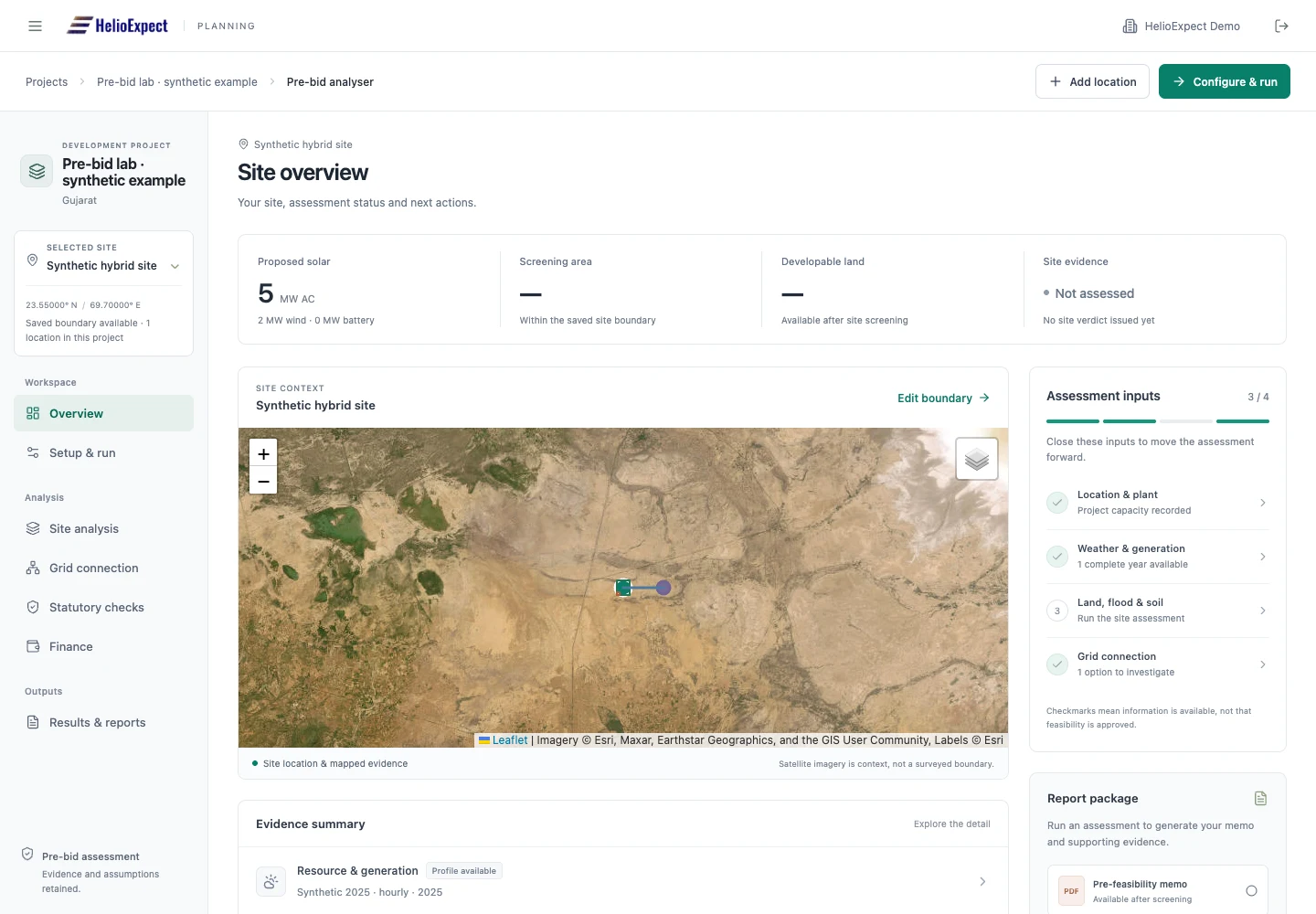
    Planner site overview with a satellite map, proposed capacity, evidence summary and assessment checklist for a synthetic hybrid project
    Start with the site. Bring location, proposed capacity, available evidence and the next assessment steps into one workspace.

    Review and handover

    Keep the basis with the result.

    Compare compatible cases, track evidence gaps and refresh studies when inputs change. Export the assessment or selected design your team actually reviewed.

    Assessment & evidence

    Pre-feasibility memo, proposed-plant assessment, source context and evidence tasks with owners, due dates and closure records.

    Design & economics

    Selected capacities, monthly delivery, lifetime pre-tax cash flows, scenarios and completed operation or battery studies.

    Engineering & review

    Relevant drawings, schedules, quantities, calculation records and open engineering issues, tied to the reviewed study.

    Proposal & handover

    A proposal package tied to the selected design revision, with supporting tables, review records and a data manifest.

    Country coverage

    Built out for India.
    Adapted by country.

    India

    The full workflow described here: regional sizing, land discovery, Pre-bid, Project Optimisation and engineering review.

    Australia

    Regional sizing and adapted land discovery and indicative Pre-bid screening. Full Project Optimisation is not enabled.

    Data coverage and specialist tools depend on the country, available evidence and configured services. Engineering outputs support review; approvals remain with the relevant specialists and authorities.

    Plan your next project

    Bring a site, a region or a delivery requirement.

    Walk through the inputs, assessment, sizing and design review with our team, using the planning decision you need to make.

    Book a Planner demo